Where it began: Harshal Kumar and the legacy of Maldives’ first Chef of the Year
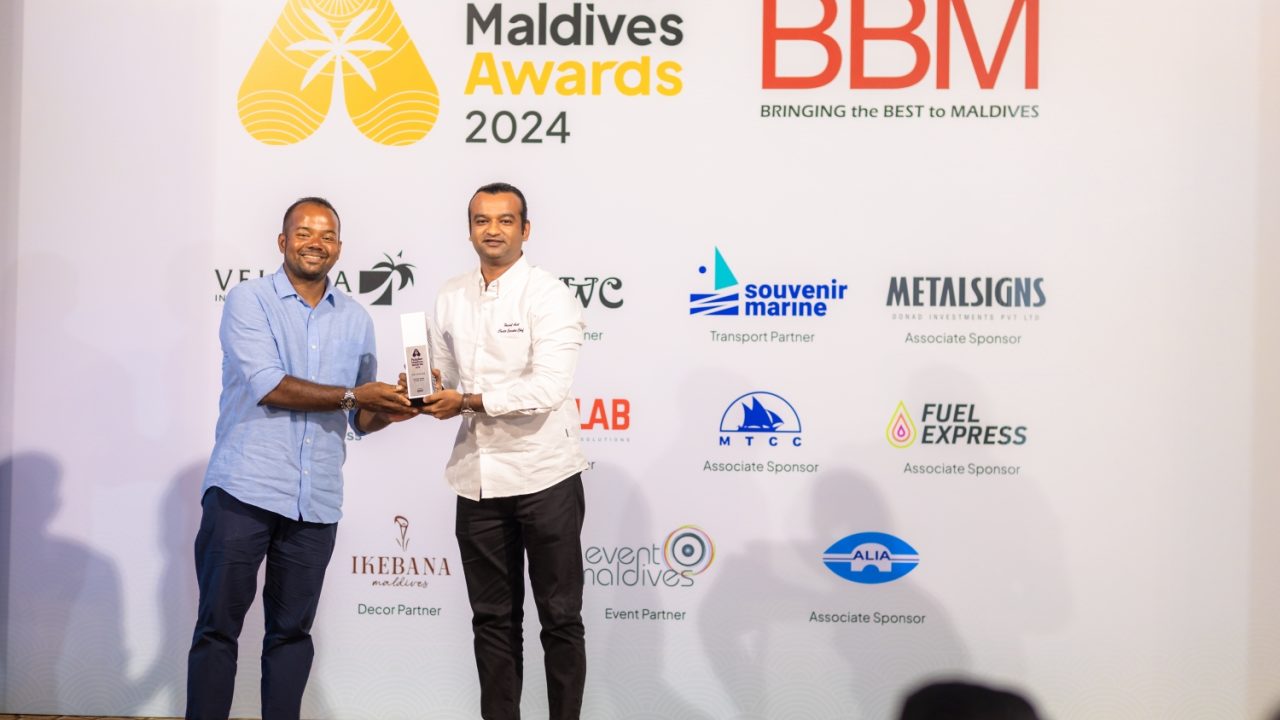
When Harshal Kumar walked away with the Chef of the Year title at the inaugural Hotelier Maldives Awards in April 2024, there was no list of previous winners against which his achievement could be measured. He was the first.
More than two years later, the distinction carries a different perspective. Hotelier Maldives has since staged two further editions of its annual awards, creating a growing roll of chefs recognised for their work in resort kitchens across the country. Ahmed Jameel of One&Only Reethi Rah succeeded Harshal in 2025, while Christian Christoffer Pedersen of The St. Regis Maldives Vommuli Resort received the Chef of the Year title in 2026.
For Harshal, however, the award is part of a much longer relationship with food, kitchens and the Maldives — one that began well before that night in 2024 and continues today at Hurawalhi Maldives.
Harshal serves as the Cluster Executive Chef for Hurawalhi Island Resort and Kudadoo Maldives Private Island, responsible for a culinary portfolio that ranges from the setting of 5.8 Undersea Restaurant to Asian-inspired Kashibo, the international offering at Canneli and the resort’s Junk Food Kitchen. It is a role that requires him to move between very different styles of dining while maintaining consistency across the operation.
His journey in the Maldives began on 2 January 2014. Coming from a professional background shaped by culinary training and experience in India, the islands offered a different type of kitchen environment: international guests, remote logistics, luxury-resort expectations and an abundance of seafood at the doorstep.
That combination would become central to his career.
Harshal has spoken particularly about the quality of fish available in the Maldives and the degree of precision required when working with delicate ingredients. For a chef, island life also presents an unusual contradiction. Some of the world’s freshest seafood can be available locally, while many other ingredients have travelled considerable distances before reaching the kitchen.
It places technique, menu planning, procurement and waste management within the same conversation.
Building a career in Maldives kitchens
Harshal’s professional journey began after studying hotel management, followed by positions in hotels and resorts in India before his career brought him to the Maldives. Over the years, his experience has included work across resort kitchens and exposure to chefs from different culinary traditions.
Among the more prominent chapters was his involvement with Gordon Ramsay’s Bread Street Kitchen pop-up at Amilla Fushi. His career has also included collaborations with chefs including Luke Mangan and Dominik Kappelar, while his competition experience includes a gold medal at the South American Chef Competition and participation within the wider Worldchefs culinary community.
By February 2024, he had been appointed Cluster Executive Chef for Hurawalhi Island Resort and Kudadoo Maldives Private Island. Only months later came the recognition that would place his name permanently at the beginning of the Hotelier Maldives Chef of the Year winners’ list.
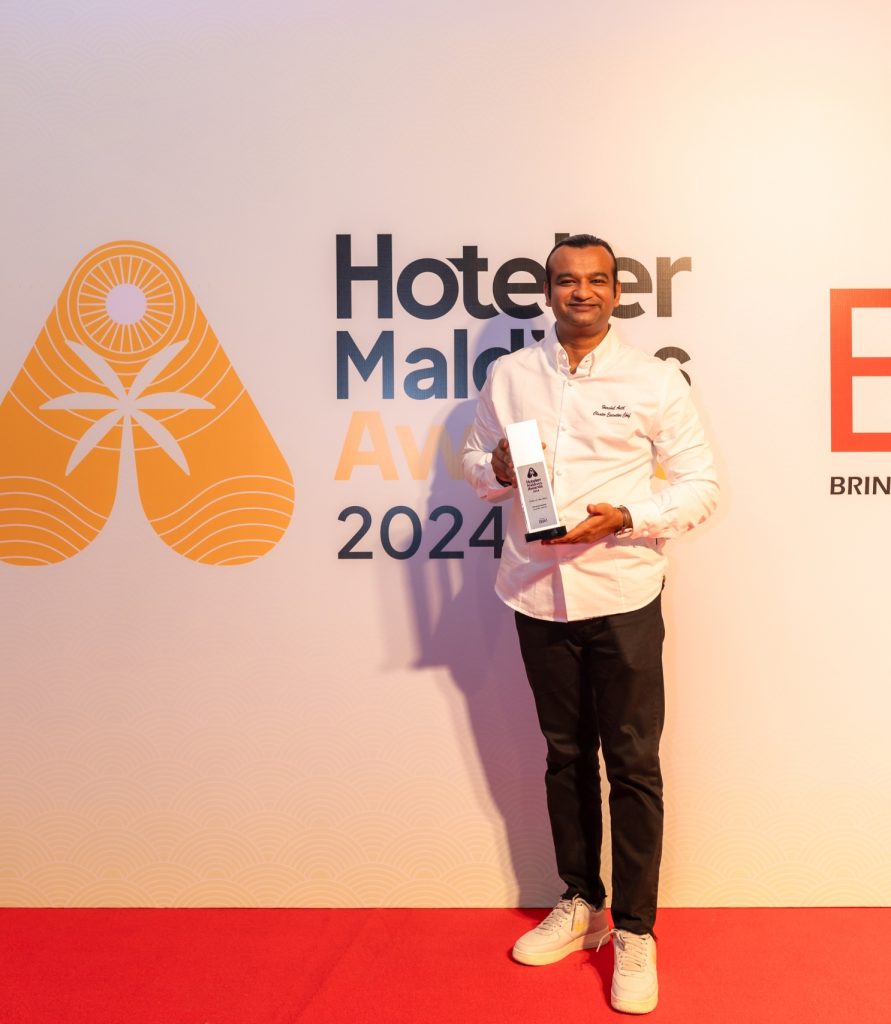
At the time, Harshal described the award not simply as an individual achievement but as recognition of the people working alongside him. He said the support of his team had given him further motivation to pursue new culinary projects.
That emphasis on the brigade is particularly relevant in resort kitchens. An Executive Chef may define menus and culinary direction, but the guest ultimately experiences the collective work of sous chefs, chefs de partie, commis chefs, pastry teams, stewards, purchasing staff and restaurant colleagues.
For young chefs working their way through those kitchens, Harshal’s own progression illustrates how a career in the Maldives can develop over time.
Different restaurants, different disciplines
Hurawalhi provides a particularly varied laboratory for a chef.
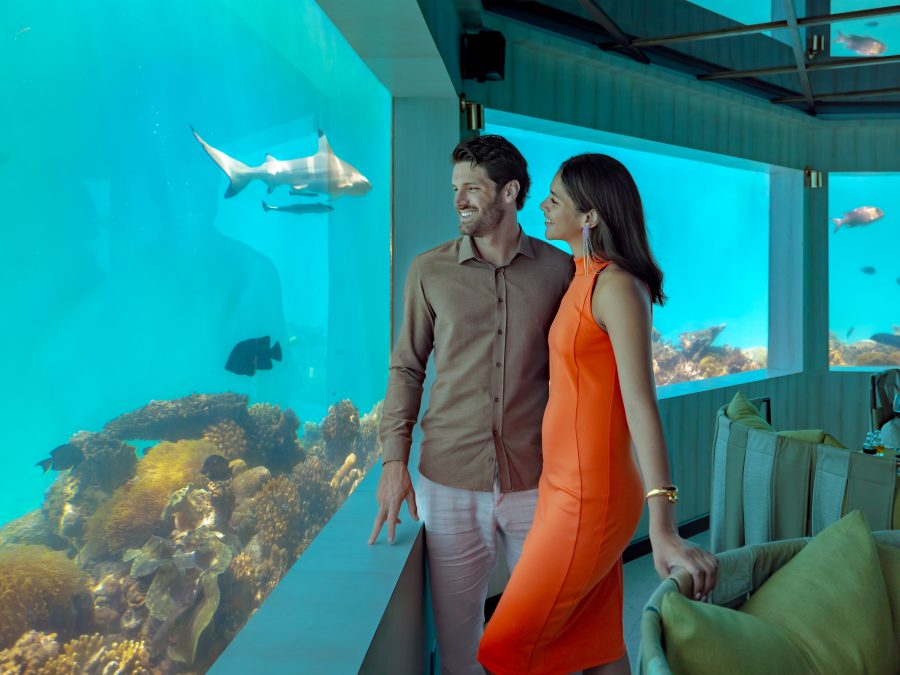
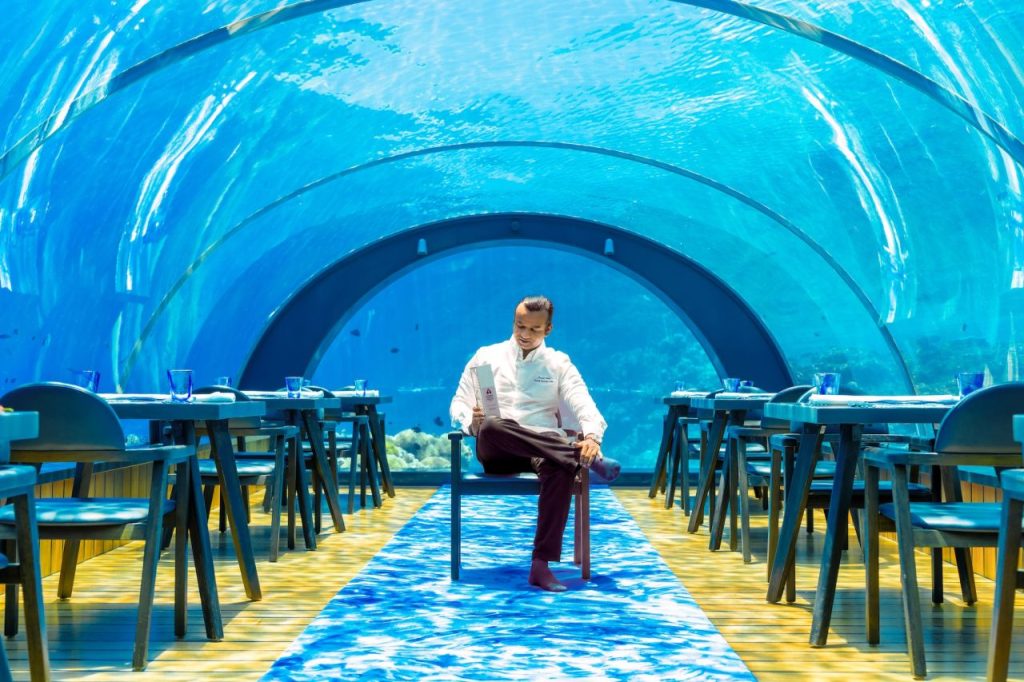
The resort’s dining operation includes 5.8 Undersea Restaurant, where the physical setting inevitably places additional attention on what arrives on the plate. There is little separation between dining and experience: guests descend below the surface of the lagoon to eat surrounded by marine life.
Elsewhere, Kashibo approaches Asian flavours in a more informal setting, while Canneli moves between buffet and à la carte service and serves guests throughout the day. Junk Food Kitchen adds another format, including a substantial focus on plant-based choices.
Operating across those outlets requires more than the ability to create individual dishes. It demands menu engineering, training, sourcing, consistency and an understanding of how guests behave differently in each dining environment.
That broader responsibility is one of the major transitions a chef makes when moving into an executive role. Cooking remains fundamental, but leadership increasingly takes place away from the stove: building teams, developing younger chefs, managing food costs, setting standards and ensuring that an idea conceived in the kitchen can be reproduced consistently during service.
For Harshal, personalisation has long been another part of that equation.
Maldives resorts welcome guests from widely different culinary cultures, often with expectations that extend beyond a fixed restaurant menu. Understanding those preferences — and sometimes recreating flavours associated with a guest’s home country — requires chefs to have a working knowledge extending far beyond a single cuisine.
It is one reason Harshal has consistently encouraged younger chefs to travel, learn about different cultures and develop their fundamentals rather than becoming confined to one style of cooking.
Sustainability inside the kitchen
Long before sustainability became a standard component of luxury hospitality communications, kitchens had practical reasons to think about it.
Every discarded ingredient carries a purchasing cost. Every unnecessarily imported product adds logistics. Packaging, food waste, portioning and menu design all have operational consequences.
Harshal has advocated approaching sustainability as part of food and beverage strategy rather than treating it only as an environmental initiative. His priorities have included reducing unnecessary packaging, finding uses for trimmings and surplus ingredients, and considering sourcing decisions as part of the culinary process.
For chefs working in the Maldives, these questions have particular relevance. Resort kitchens operate on islands where waste has to be managed, imported ingredients arrive through complex supply chains and the surrounding marine environment is part of the very product tourism depends upon.
The challenge is therefore not simply to produce sophisticated food. Increasingly, it is to do so with greater awareness of what comes into the kitchen, what leaves it and what can be used more intelligently in between.
An award that has grown around its first winner
When Harshal received Chef of the Year in 2024, the Hotelier Maldives Awards itself was new. The inaugural edition attracted more than 300 nominations across the hospitality industry and around 100,000 public votes.
By its second edition in 2025, participation had expanded to more than 450 nominations and approximately 600,000 public votes. The Chef of the Year honour also evolved, with Ahmed Jameel receiving both Chef of the Year and the BBM Chairman’s Special Award for Chef of the Year.
In April 2026, the awards returned for their third edition. Christian Christoffer Pedersen of The St. Regis Maldives Vommuli Resort became the latest recipient, recognised for work spanning culinary concepts, sustainability, guest satisfaction and kitchen-team development.
Three editions now provide the beginnings of a lineage.
Harshal Kumar. Ahmed Jameel. Christian Christoffer Pedersen.
Different chefs, different properties and different culinary operations, but together they reflect something important about the development of the profession in the Maldives: chefs are increasingly being recognised not only for what they cook, but for how they lead, train, innovate and influence the wider resort operation.
Harshal’s place in that story will always be distinctive. His name occupies the first line.
The fundamentals remain
Recognition can change a chef’s profile, but it does not change the foundations of the profession.
Kitchens continue to run on preparation, repetition, discipline and teamwork. Senior positions may bring larger responsibilities and greater visibility, but the fundamentals that take someone from a junior kitchen role to Executive Chef remain remarkably consistent.
That is also at the heart of Harshal’s advice to emerging chefs: build strong basic skills, keep learning, take on unfamiliar challenges and expose yourself to different cultures and cuisines.
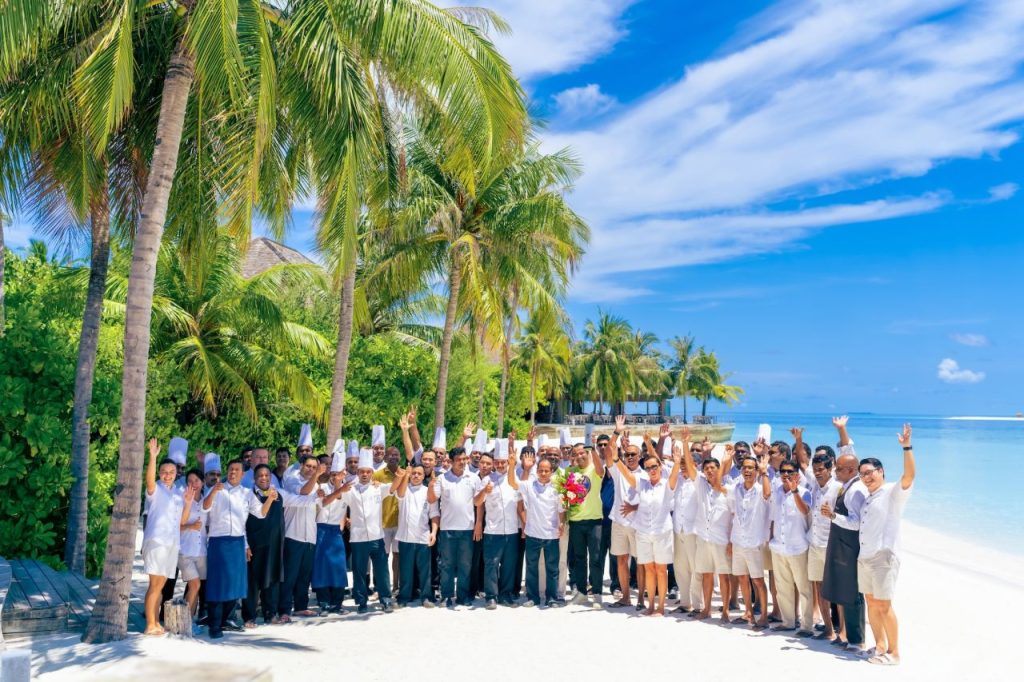
It is advice particularly suited to the Maldives.
Few culinary destinations bring together such an international concentration of chefs, guests, ingredients and dining concepts within such a small geographical area. A chef can work with Maldivian tuna in the morning, prepare an Asian menu in the afternoon and develop a European-influenced tasting menu for dinner — all while working alongside colleagues from several countries.
For those willing to learn from it, the resort kitchen can become as much a classroom as a workplace.
More than two years after becoming Hotelier Maldives’ inaugural Chef of the Year, Harshal Kumar’s story is therefore about more than being first.
The award marked a moment in his career. What came before it — years of learning, competition, collaboration and progression — made that moment possible. And what follows it is the part that matters to the next generation of chefs watching from their own sections of Maldives kitchens.
Awards capture achievement on a particular night. A culinary career is built during all the services in between.
Awards Crown & Champa Resorts Hotelier Maldives Hotelier Maldives Awards Hotelier Maldives Awards 2024 Hurawalhi Maldives Kudadoo Maldives Private Island THE OZEN COLLECTION